Yeti in My Spaghetti Speech Therapy: Playful, Goal-Focused Ideas for Preschool & Early Elementary
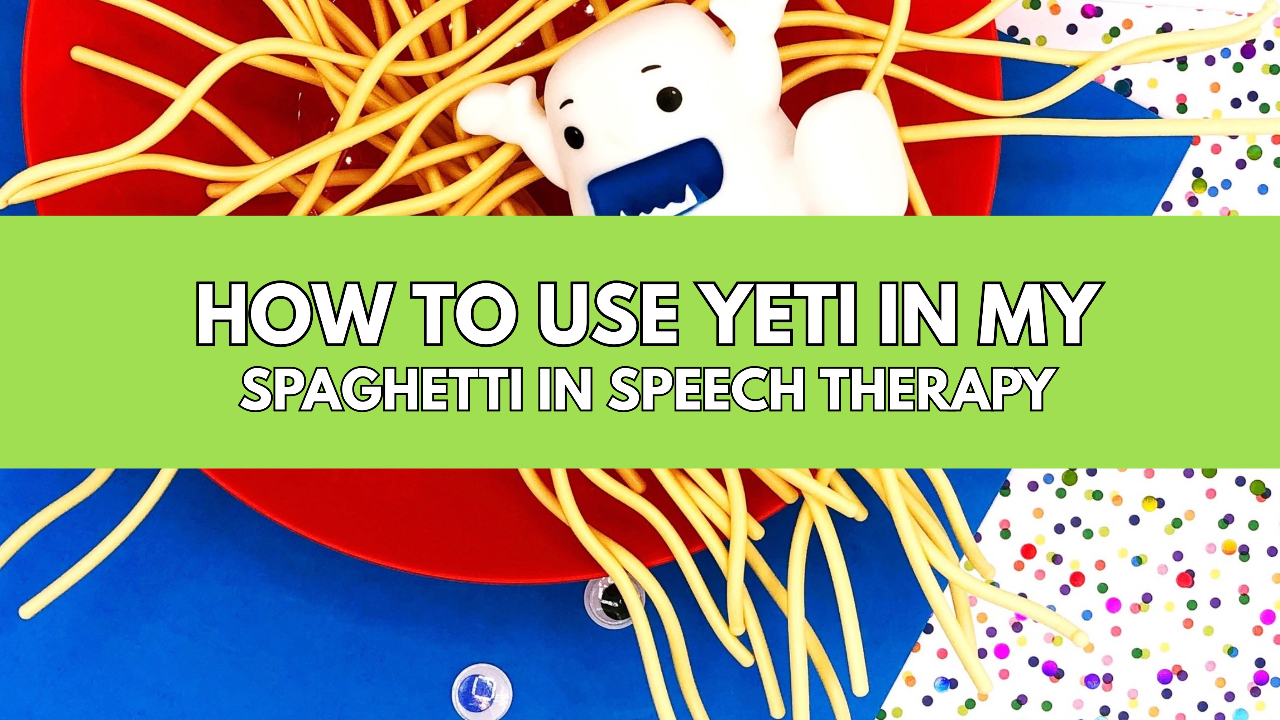
If you’ve ever played Yeti in My Spaghetti, you already know why kids can’t get enough of it. This goofy little game- where a mini yeti balances on a pile of wobbly “noodles” - has all the suspense and laughter you could ask for in therapy. Players take turns removing noodles one by one, trying not to make the yeti fall into the bowl. Simple? Yes. But in speech therapy, that simplicity is exactly what makes it magic.
In this post, we’ll explore how to use Yeti in My Spaghetti in speech therapy with toddlers, preschoolers, kindergarteners, and early elementary students. You’ll discover why it’s so motivating, easy ways to target articulation, vocabulary, verbs, and social language through play, plus a few yeti-themed books and songs to extend the fun. By the end, you’ll have actionable, play-based ideas to transform Yeti in My Spaghetti into a go-to therapy tool.
Why Kids (and SLPs) Love Yeti in My Spaghetti
1. High on Fun, Low on Rules
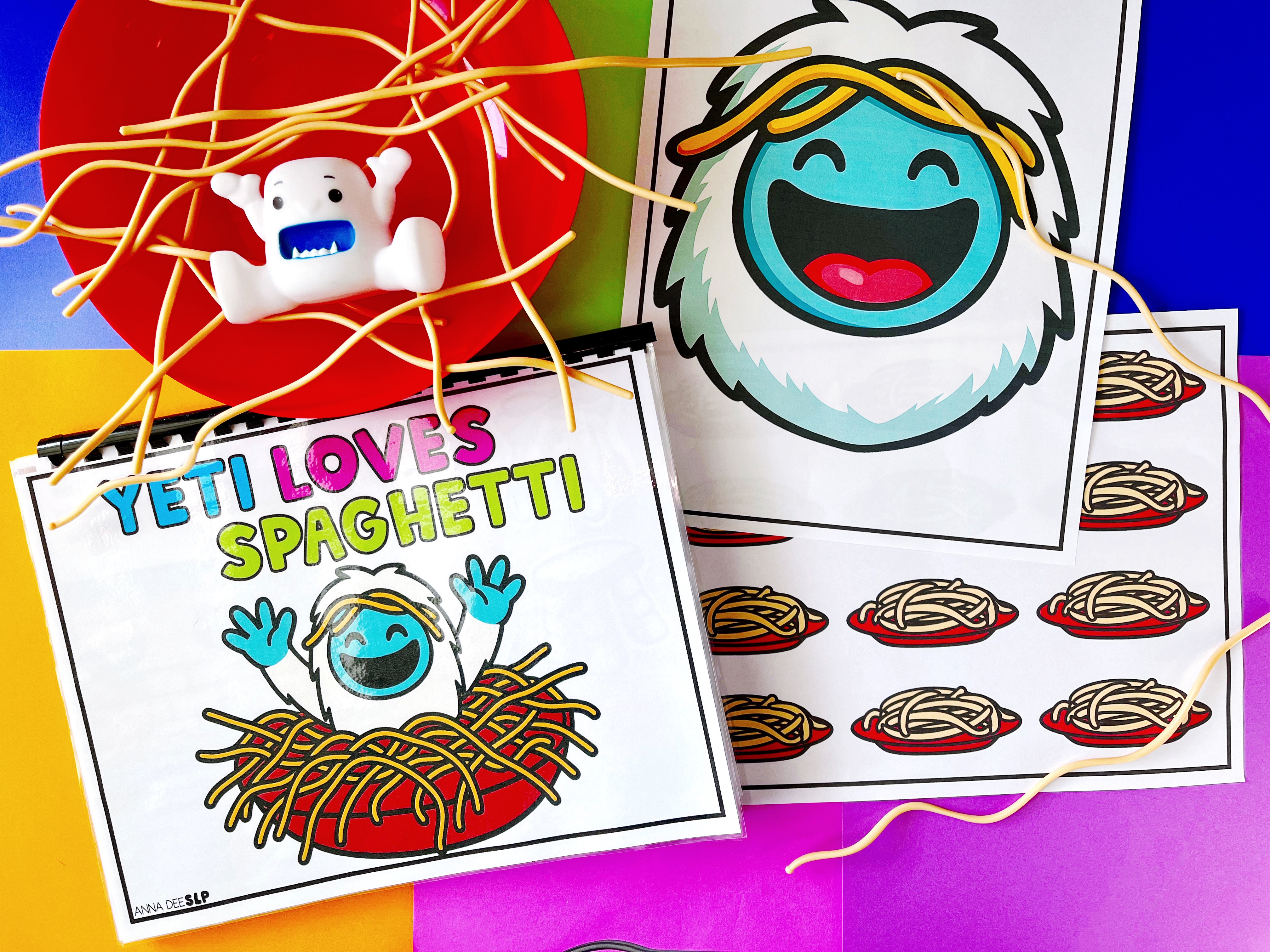
Yeti in My Spaghetti is refreshingly simple - just balance the noodles across the bowl, perch the yeti on top, and take turns removing one noodle at a time… until, plop! The yeti falls.
That element of suspense (“Uh-oh, he fell!”) never fails to capture kids’ attention. Because there are so few rules, children can jump right in and focus on the interaction—not memorizing directions. The game is quick to reset and plays fast, which is perfect for little attention spans.
2. Quick Turns = Tons of Practice
Each noodle pull takes just seconds, meaning students get lots of turns and plenty of opportunities for practice. Before each turn, have them say a target word, answer a question, or complete a short task related to their goal.
Fast rounds = high engagement = more speech and language trials in less time. That’s every SLP’s dream!
3. Built-In Skill Building
While it’s all giggles on the surface, Yeti in My Spaghetti naturally supports social communication skills - waiting, turn-taking, encouraging peers, and managing winning or losing. Every time a child cheers, laughs, or says “Uh-oh!”, they’re practicing expressive language and social-emotional regulation.
It’s also perfect for negation (“Don’t drop the yeti!”), cause/effect (“He fell because you pulled that noodle!”), and basic concepts like in, on, under, and off.
4. Fine Motor + Focus
Pulling those thin, wiggly noodles requires control and precision. Kids strengthen fine motor skills and focus as they play. It’s a win-win for both language and coordination.
When children feel successful managing small tasks, their confidence grows and so does their willingness to communicate.
5. The Silly Factor
Honestly? The absurd combination of a tiny yeti and spaghetti noodles is just plain hilarious. And laughter is one of the most powerful motivators in therapy.
When kids are laughing, they’re relaxed, engaged, and talking more freely. Play-based activities like this create a natural, low-pressure environment where authentic communication thrives.
🎯 Targeting Speech & Language Goals with Yeti in My Spaghetti
One of the best things about using games in speech therapy is how adaptable they are. With a little creativity, Yeti in My Spaghetti can target nearly any goal! Use it for anything from articulation and vocabulary to social communication and following directions.
Below are several easy, play-based ways to integrate your students’ speech and language objectives naturally into this silly, engaging game.
Articulation & Phonology Practice
Turn every noodle pull into a quick articulation trial!
-
Have your student earn a turn by saying a target sound or word 3–5 times correctly.
-
For carryover, have them use the word in a sentence before pulling (e.g., “The spaghetti is soft” for /s/).
By the end of one round, your student may have practiced 20+ productions - without it ever feeling like drill work.
For a play based approach, you can practice words that naturally come up while playing Yeti in My Spaghetti.
For /p/, model words like pull, plop, put, play, pasta, plate, pick, up, and happy. For /b/, try bowl, balance, big, bend, below, and before.
The /t/ sound naturally fits with tiny, top, take, turn, two, tight, tall, and table, while /d/ words include down, drop, did, don’t, noodle, ready, and under.
For /k/ and /g/, use words such as careful, catch, color, cook, go, game, giggle, and get.
The /f/ sound appears in fall, food, fun, four, fast, and full. You can also work on /s/ words like soft, silly, sit, say, same, sound, and sauce, or /ʃ/ (“sh”) words like shake, show, short, she, and should.
If you’re targeting /z/, try easy, dizzy, nose, and lazy, and for /l/ practice, use fall, bowl, little, yellow, noodle, like, and laugh. For /r/, model red, ready, right, turn, three, and around.
The /θ/ and /ð/ sounds can be practiced with think, three, there, that, and this. For /v/, include very, move, over, and give. You can also incorporate /r-blends like grab and great, and, as well as /s-blends such as spaghetti, spill, slow, small, smile, and stick. For /l-blends, try blue, clean, slide, and sleep, while /r-controlled vowels can be targeted with star, stir, far, and first.
Don’t forget about /h/ words like happy, have, help, hold, and high, or /m/ targets such as more, my, make, move, and mess. For /n/, you can use noodles, no, in, on, under, and funny.
The /w/ sound fits perfectly with wobble, wait, wow, what, when, and where.
You’ll naturally hit the /j/ (“y”) sound with yeti, yellow, and yes, while /ʧ/ (“ch”) words like, catch, much, and each work well too.
Of course, sprinkle in fun functional exclamations throughout the game—uh-oh, oh no, yay, oops, wow, and good job—to keep play natural and motivating.
Early Vocabulary & Basic Concepts
Yeti in My Spaghetti makes it easy to model and reinforce early language concepts. During play, highlight:
-
Spatial prepositions: in, on, under, off, up, down
-
Quantitative words: more, less, empty, full
-
Describing words: long, short, wiggly, soft, round
-
Negation: “Don’t drop the yeti!” or “No fall yet!”
Label and categorize as you go—noodle (food), yeti (creature), bowl (kitchen item). You’re expanding vocabulary and conceptual understanding in a natural, high-interest way.
Functional Language & Core Phrases
This game is perfect for practicing everyday communication in context. Encourage short, functional phrases such as:
“My turn.” “Your turn.” “More noodles, please.” “Yeti fell down!” “Help me!”
Because the actions repeat each round, kids get multiple chances to use and generalize these phrases.
For AAC users, model symbols for go, stop, fall, up, down, and help on their device or board to encourage active participation.
Action Words (Verbs)
Each noodle pull is a chance to highlight verbs in real time. Narrate and have the child imitate or complete the sentence:
“You’re pulling the noodle… you pulled it out!”
“The yeti is balancing… now he’s falling!”
Target verb tenses naturally (present, past, and -ing forms) while emphasizing contrasts like drop vs. fall. Because the actions are so visual, kids grasp meaning quickly and remember the words long-term.
Wh-Questions & Following Directions
Simple setup = endless comprehension opportunities!
Ask questions as you play:
-
“Who made the yeti fall?”
-
“Where is he now?”
-
“Why did he fall?”
Or add following directions, such as:
-
“Before you pull a noodle, clap twice.”
-
“After you pull one, say ‘uh-oh!’”
Try hiding the noodles or yeti around the room for a mini scavenger hunt - great for combining listening, movement, and spatial concepts like under, on top, and behind.
Why This Works
Games like Yeti in My Spaghetti give you loads of language-rich opportunities in a single session. When kids are engaged and anticipating that dramatic “plop,” they’re motivated to talk, listen, and respond without realizing how much practice they’re getting.
The key? Be intentional with your prompts, but keep it light and fun. Therapy goals become part of the game’s rhythm instead of a separate “task.”
Ideas by Age Group: Toddlers to Early Elementary
Yeti in My Spaghetti is recommended for ages 4+, but with supervision (and a few creative tweaks), you can use it successfully from toddlerhood through early elementary. Below are developmentally appropriate ways to adapt the game for different ages and goals.
Toddlers (around ages 2–3)
At this stage, success looks like connection, imitation, and joy. You might not follow all the rules—focus instead on shared play and communication.
Simplify the play
Skip the competition and turn it into a cause-and-effect exploration. Let toddlers pull noodles freely (you control the pieces for safety). Every time the yeti drops, model surprise—“Uh-oh, Yeti fell down!”—and celebrate the moment. That repetition builds understanding of actions and outcomes.
Model single words and fun sounds
Keep language short and rhythmic. Use exclamations like go, pull, fall, up, down, boom, and uh-oh! Toddlers love repeating them. Each joyful reaction is communication practice.
Support early turn-taking
Point to yourself: “My turn,” then gently cue the child: “Your turn!” Short turns keep waiting manageable. Praise any attempt to imitate or wait—“You waited—nice listening!”
Prioritize safety
Because of small pieces, supervise closely. You can swap in uncooked spaghetti or yarn noodles for safer exploration, or just let toddlers handle the bowl and yeti while you manage the rest.
For toddlers, engagement is the goal. Even a single new word, sign, or shared giggle is a communication win.
Preschoolers (ages 3–4)
Preschoolers thrive on games with clear, simple rules—and Yeti in My Spaghetti fits perfectly.
Introduce easy structure
Explain visually: “We take turns. Pull one noodle carefully. If Yeti falls—uh-oh!—we laugh and start again.” Predicting when he’ll fall builds attention and vocabulary (fall, not yet, more, all done).
Expand utterances
If a child says “Yeti fall,” expand it: “Yes, the yeti fell down!” or “The yeti fell in the bowl.” Repetition of short, structured sentences helps grammar grow naturally.
Reinforce preschool concepts
Count noodles together, compare long vs. short, and model more/less and spatial terms (left, right, under, behind). Use gestures or visual cues to strengthen understanding.
Add imaginative play
Turn the yeti into a character. Pretend he’s hungry—“Let’s cook him spaghetti!”—or make him walk across a “spaghetti bridge.” Encourage narration and pretend-play verbs like stir, eat, give, and fall.
Connect with books and songs
After the game, extend the theme with a story such as Never Feed a Yeti Spaghetti or How to Catch a Yeti. For movement, sing “Going on a Yeti Hunt” to practice following directions and concepts like over, through, and around.These tie-ins reinforce vocabulary and keep sessions fresh.
Preschoolers often beg to play again and that repetition is exactly what builds mastery. Vary your focus each round (verbs, prepositions, describing) to keep goals embedded in play.
Kindergarten (ages 5–6)
Kinders love the silly suspense of the yeti but are ready for added challenge and academic links.
Model longer sentences and retelling
Prompt complete sentences: “I removed one noodle and the yeti is still balancing!”
After the game, practice sequencing: First we set up, then we took turns, finally the yeti fell.* Using time words builds narrative and classroom-ready skills.
Coach social language and sportsmanship
In small groups, assign one child as the “rule explainer.” Practice polite phrases like “It’s your turn,” “Can you pass me the bowl?” and “Good game!” Model flexible thinking when the yeti falls—“That’s okay, let’s try again!”—to support emotional regulation.
Add a challenge
Use a “challenge card” deck with quick tasks: “Name two animals,” “Use because in a sentence,” or “Do five jumping jacks.” This keeps the game engaging while targeting categories, sentence structure, and following directions.
Early Elementary (ages 6–8)
Older kids still love the humor—but you can bump up the language level to keep it age-appropriate.
Articulation carryover
Have students use target sounds in conversational comments each turn: “This game is silly,” “Do you see him wobbling?” Reflect after play—“You used great /s/ sounds!”—to reinforce awareness.
Higher-level vocabulary and reasoning
Ask open-ended questions: “Why do you think the yeti fell?” “Which noodle is most important?” Encourage explanations using because, so, and descriptive phrases.
Social reasoning and self-regulation
Discuss handling frustration and fairness: “What could you say if a friend got upset?” Model calm reactions (“Oops! I made him fall—no big deal!”) to teach perspective-taking and flexibility.
Keep it challenging
Add a team goal—“Can we remove five noodles in one minute without the yeti falling?”—to promote collaboration and problem-solving.
Even first- and second-graders enjoy a quick yeti round as a reward or break from desk work. It’s a lighthearted way to practice higher-level skills while keeping therapy joyful.
More Yeti Fun: Books, Songs, and Activities
One of the best ways to stretch your Yeti in My Spaghetti session is to build a full mini-theme around it! Connecting the game with related books, songs, and hands-on activities helps kids deepen vocabulary, comprehension, and engagement - all while having a blast.
Yeti-Themed Books for Speech Therapy
Here are a few yeti-inspired stories that pair perfectly with your game:
1. Never Feed a Yeti Spaghetti
This silly, rhyming book is the perfect companion to the game! Each page warns not to feed a certain animal a funny food — until we meet the yeti and his spaghetti. It’s great for working on negation (“never feed…”), vocabulary, and describing textures.
2. How to Catch a Yeti
From the popular “How to Catch…” series, this story invites kids to predict, infer, and use cause/effect language: “Why can’t they catch him?” “What will they try next?” It’s full of action words and past-tense practice. You can also check out my no prep book companion craft sheet for this story!
3. The Thing About Yetis
A charming story that contrasts winter and summer, offering rich opportunities for discussing opposites, seasons, and descriptive language. Ask wh-questions like “What do yetis do in summer?” or “What do they wear in the snow?”
4. Spaghetti with the Yeti
This delightful book ties the spaghetti theme right back to your game. It’s perfect for sequencing (“first he met the yak, then the kraken…”), rhyming, and vocabulary expansion through vivid imagery.
You can easily extend your session by pairing a quick read-aloud with the game — or acting out parts of the story using your yeti figure. For example, after reading Never Feed a Yeti Spaghetti, pretend to “feed” the yeti various foods and have the child decide what’s okay or not. (“No, no, don’t feed the yeti pizza!”)
Songs & Movement Activities
Music and movement help little ones process language through rhythm and repetition. Try one of these yeti-themed ideas to get the wiggles out between rounds of gameplay:
-
“We’re Going on a Yeti Hunt” (by The Kiboomers on YouTube): A fun twist on We’re Going on a Bear Hunt, this song lets you practice following directions, repeating phrases, and using spatial concepts (over, through, around).
-
“Yeti Says” Game: Play it like Simon Says! Give silly yeti commands — “Yeti says jump two times!” “Yeti says roar!” “Yeti says tiptoe through the snow!” Great for listening, imitation, and action verbs.
-
If You’re a Yeti and You Know It: Adapt If You’re Happy and You Know It — “If you’re a yeti and you know it, stomp your feet!” Perfect for reinforcing verbs and body part vocabulary.
These quick transitions double as natural language opportunities — every roar, stomp, and giggle builds communication confidence.
Bonus Yeti-Themed Play Ideas
If you want to go all-in on your yeti theme, try adding one of these easy, low-prep activities:
Yeti Sensory Bin:
Fill a bin with cotton balls or white pom-poms to make “snow.” Add toy trees, rocks, and a mini yeti figure. Hide a few noodles or picture cards underneath and have kids dig for them using clues (“Find the noodle under the snowball!”). This activity supports positional concepts and sensory exploration.
Feed the Yeti Craft:
Make a simple yeti face using a paper bag or cup with a big open mouth. Cut yellow yarn into “spaghetti” strands. Have students “feed” the yeti noodles each time they say a word, answer a question, or use a target phrase. It’s an engaging way to work on articulation or expressive language — and they can take it home for extra practice!
Therapy Tip: Themed play keeps motivation high, but remember you don’t need to overcomplicate it. Even one add-on (like a short story or quick craft) makes your session feel new and purposeful without adding a ton of prep.
FAQs About Yeti in My Spaghetti in Speech Therapy
Q: How do I use Yeti in My Spaghetti in speech therapy?
Use the game as a fun, flexible way to practice speech and language goals. Before each turn, have the child say a target word, answer a question, or complete a language task. During the game, model and expand on language naturally: “Pull the noodle,” “Uh-oh, he fell!” Each turn becomes a meaningful chance to communicate.
Q: What goals can this game target?
So many! You can address articulation, phonology, expressive/receptive language, social skills, and even fluency. Examples include:
-
Articulation: Say a target word or sentence before each turn.
-
Vocabulary & Concepts: Work on in, on, under, more, less, and descriptive words.
-
Social Language: Practice turn-taking, polite phrases, and flexible thinking.
-
Fluency: Use it as a relaxed setting to apply fluency strategies.
Q: Can toddlers play Yeti in My Spaghetti?
The game is labeled 4+, but you can safely adapt it for toddlers under close supervision. Use larger substitute noodles (like yarn or cooked spaghetti) and focus on simple words (go, up, down, fall). The goal is interaction and imitation — not rule-following.
Q: How does playing games like this help with speech and language?
Play creates motivation and connection. When kids are laughing and engaged, they naturally communicate more. Games like Yeti in My Spaghetti provide authentic opportunities for repetition, turn-taking, and problem-solving — all essential for language growth.
Q: What if my student just wants to make the yeti fall immediately?
That’s totally normal! Set clear expectations (“First we say our word, then we pull one noodle”). You can also make the yeti’s fall the “grand finale” — build anticipation and save it for the end. This helps with self-regulation and keeps the focus on communication.
Wrap-Up & Next Steps
Yeti in My Spaghetti is one of those rare games that’s equal parts silly and skill-building. It’s quick, flexible, and endlessly adaptable for speech and language goals — from single-word practice with toddlers to narrative retells with early elementary students.
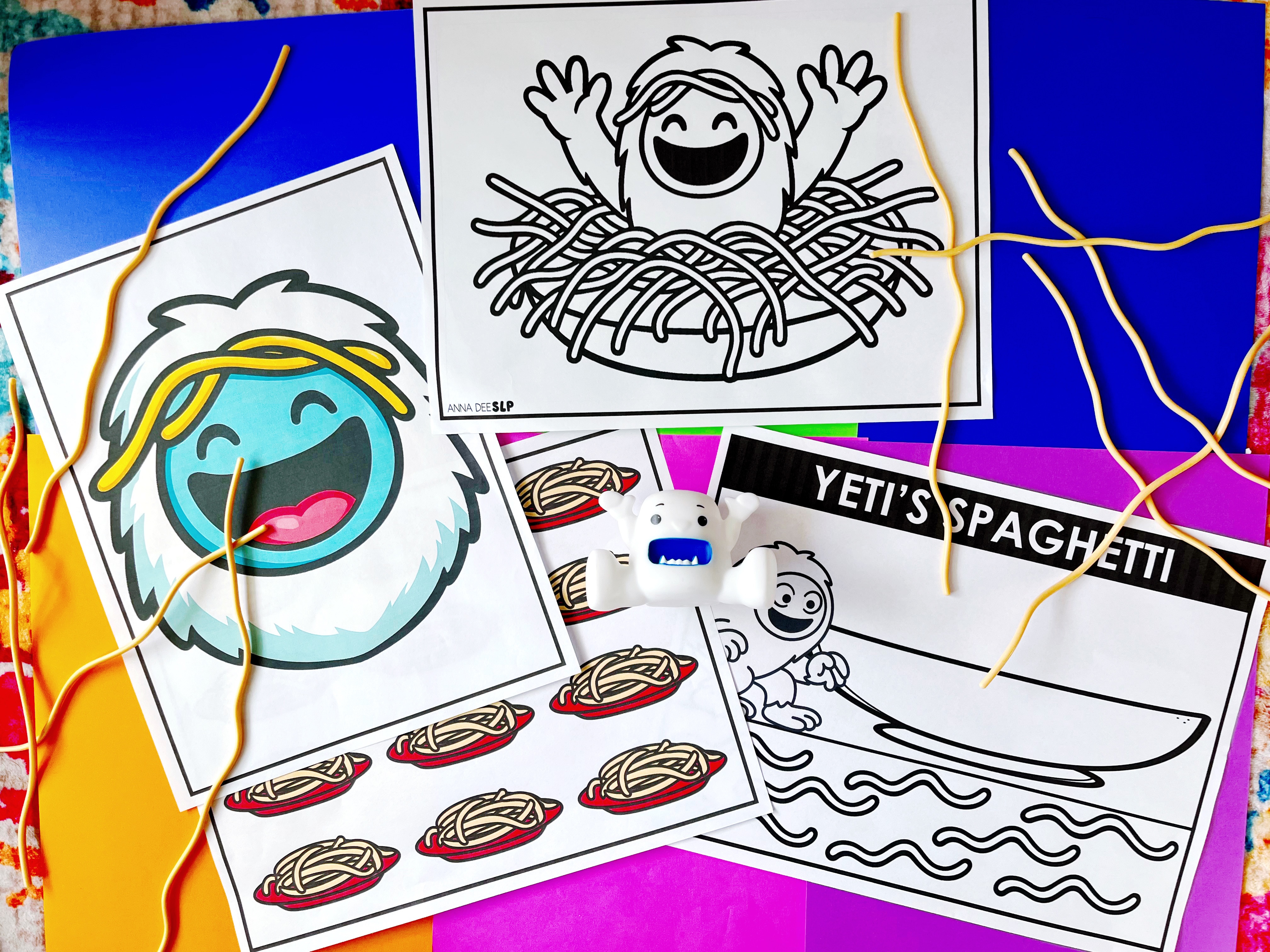
If you’re ready to make planning easier, grab one (or both!) of my Yeti-themed therapy resources:
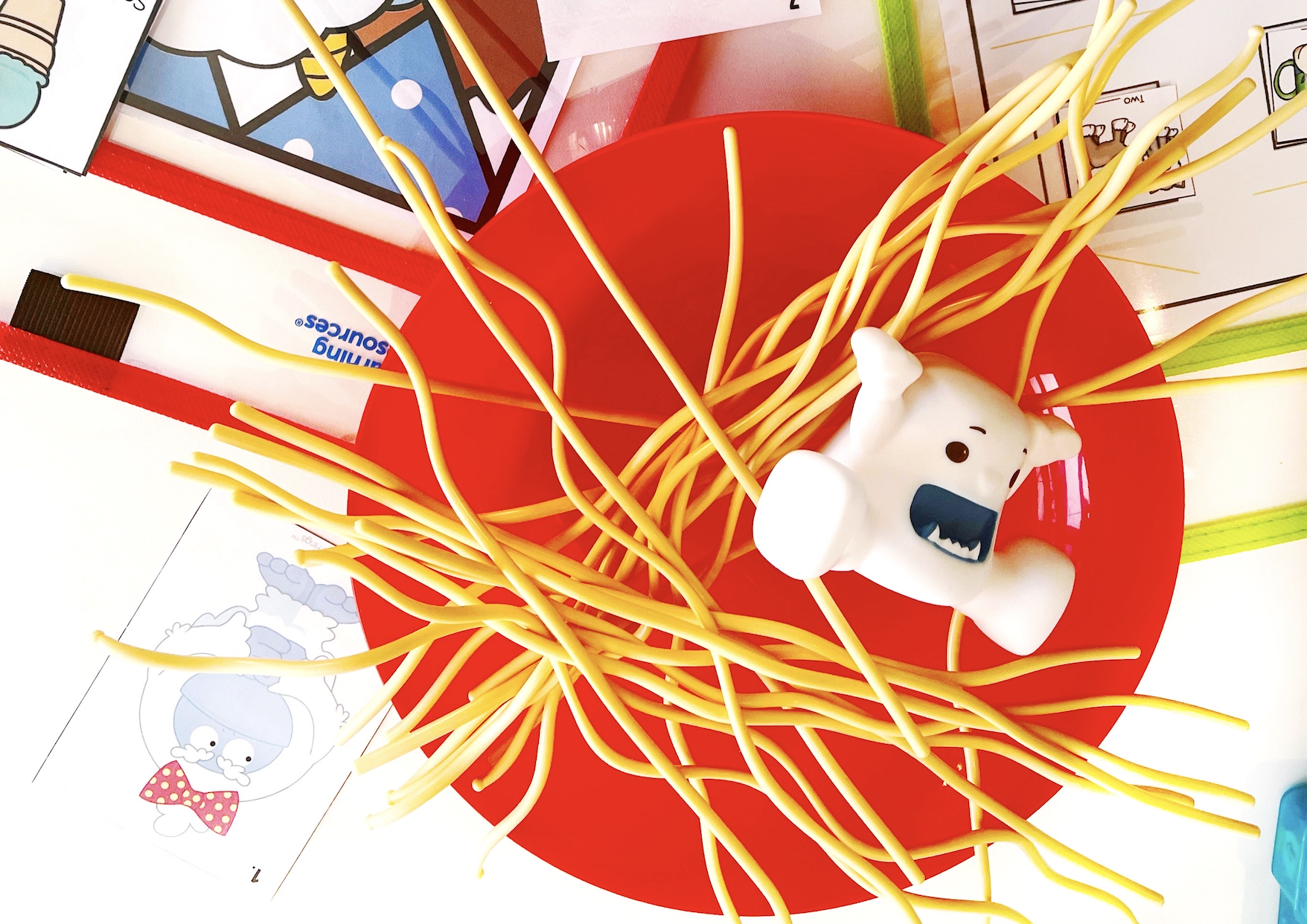
1. Yeti in My Spaghetti Game Companion – A fun, ready-to-use set of activities designed specifically for play with the Yeti in My Spaghetti game. Includes articulation and language targets, visual supports, and extension activities that keep kids laughing and learning.
2. Yeti Interactive Book for Speech Therapy –This interactive story brings the yeti’s “origin story” to life! Kids get to help make choices on each page — building engagement, inferencing, and language skills along the way. It’s a great tool for targeting vocabulary, describing, and story sequencing with a playful twist. It’s also a perfect tie-in before or after the game for literacy-based therapy.
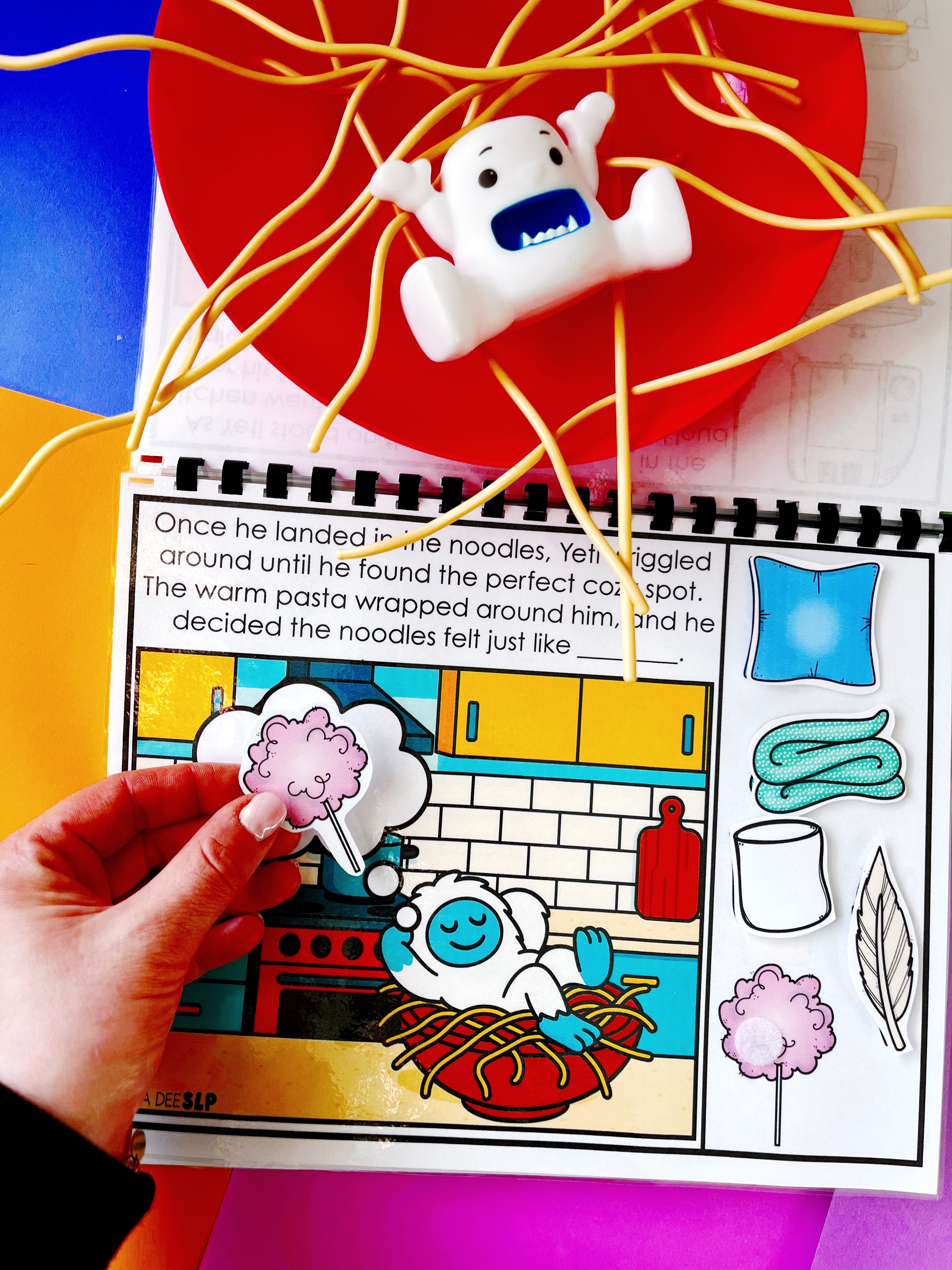
Each resource can stand alone, but they work even better together for a fully themed therapy week your kids will beg to repeat.
Check them out in my TpT store → SNAG THE MONEY SAVING BUNDLE!
Meanwhile, if you’re hungry for more play-based therapy ideas, be sure to explore these related posts on my blog:
-
Pop the Pig Speech Therapy: Fun Ideas for Preschool & Early Elementary – Another silly game turned therapy goldmine, with tips similar to our Yeti game ideas.
-
Yeti Themed Speech Therapy Lesson Plan – Plan a whole session around yetis! Includes book recommendations and bonus activities (sensory bin, movement, etc.) for a wintery Yeti theme.
-
Best Games for Speech Therapy – A roundup of top quick-play games (including pop-up and balance games) that pack in trials and keep kids motivated . Great for expanding your therapy game collection!
(Need more free therapy resources? Join my mailing list for exclusive freebies, insider tips, and updates – like a free list of easy prep games and activities!*)
Let's stay connected!
Join the mailing list to receive updates with new freebies, promos, and specials!
Don't worry, your information will not be shared.
We hate SPAM. We will never sell your information, for any reason.